 11
11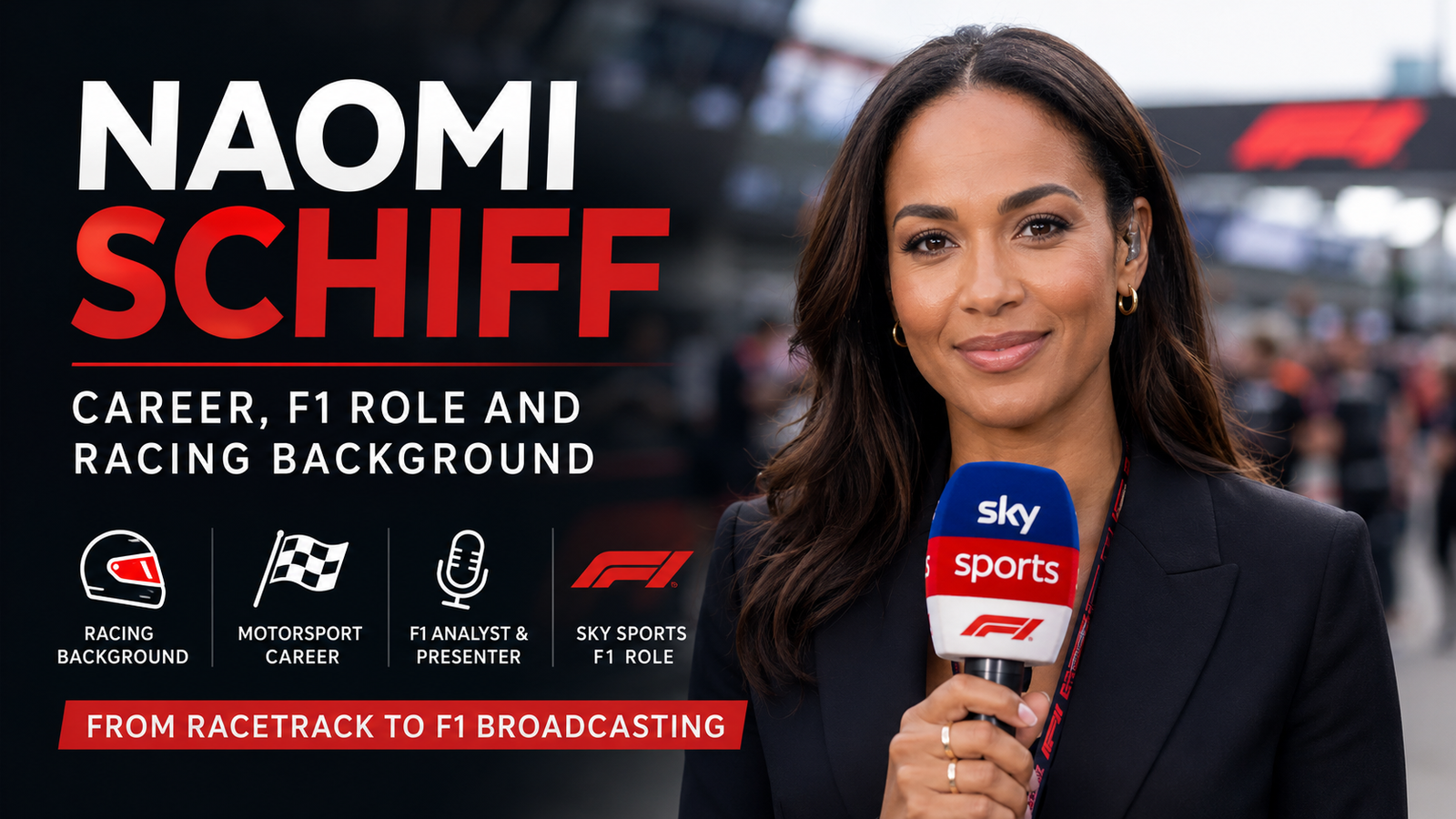
Naomi Schiff is a Rwandan-Belgian former racing driver, television presenter and Formula 1 analyst. She is best known to many fans for her work with Sky Sports F1, where she contributes as part of the broadcaster’s expert and analyst team.
Sky Sports announced Schiff’s arrival for its Formula 1 coverage in 2022, describing her as a professional racing and stunt driver who would join the presentation team and co-host Any Driven Monday. Sky also highlighted her background in karting, single-seaters, GT cars and prototype racing.
Her profile stands out because she has lived several sides of motorsport. She has been a driver, a competitor in women-focused racing, a diversity and inclusion ambassador, a presenter and an F1 analyst. That combination makes her career especially interesting for fans who want to understand how racing experience can translate into media work.
Rather than being known for one single achievement, Naomi Schiff is recognised for a broad motorsport journey. She has built credibility through competition, communication and representation.
Naomi Schiff was born in Belgium and is of Rwandan-Belgian heritage. She grew up in South Africa, a background that gave her career an international identity from the start. Speakers Academy describes her as a Rwandan-Belgian racing driver and television presenter who was born in Belgium, grew up in South Africa and later lived in Paris.
Her interest in motorsport began at a young age. Like many professional drivers, Schiff started in karting before progressing into higher categories. Karting is often the first serious step for drivers because it teaches racecraft, braking discipline, overtaking, defensive driving and vehicle control.
For a young driver, karting is more than a hobby. It builds the foundation for everything that comes later. Drivers learn how to read grip levels, understand racing lines and handle pressure in close competition. Naomi Schiff’s early karting experience helped prepare her for the technical and mental demands of professional racing.
Naomi Schiff began racing in karts before moving into single-seater, prototype and GT racing. Sky Sports noted that she started karting at the age of 11 and later raced in prototype, GT and single-seater cars.
This variety is important. Some drivers follow a straight path through karting, Formula 4, Formula 3 and higher single-seater categories. Schiff’s route was broader. She gained experience in different machinery, which likely helped her develop a wider understanding of motorsport.
Her racing background included:
Each discipline requires a slightly different skill set. Single-seaters demand precision and confidence in high-downforce cars. GT racing requires adapting to heavier cars and often working closely with team-mates. Endurance racing demands consistency, patience and mental strength over long distances.
That range of experience now supports her work as an F1 analyst. When discussing drivers, strategy or pressure, she can draw from real competition experience.
Naomi Schiff’s racing career included several notable achievements. One of her key results came in 2014, when she won the Clio Cup China Series. Sky Sports also listed her 2018 KTM GT4 X-Bow Battle Championship title and second place in the 2018 ADAC Zurich 24 Hours Nürburgring as major career achievements.
Speakers Academy similarly notes that she won the 2014 Clio Cup China Series with seven wins from ten races and later competed in the KTM X-Bow GT4, GT4 European series and endurance racing.
| Area | Naomi Schiff’s Experience |
|---|---|
| Karting | Started racing at a young age |
| Single-seaters | Competed after moving up from karting |
| Clio Cup China Series | Won the 2014 championship |
| GT Racing | Competed in KTM X-Bow GT4 machinery |
| Endurance Racing | Took part in major endurance events |
| Nürburgring 24 Hours | Finished second in class in 2018 |
| W Series | Competed in the inaugural 2019 season |
These achievements show that Schiff’s racing career was not limited to one category. Her experience across different formats gives her a strong base for analysing motorsport from multiple angles.
The W Series played an important role in Naomi Schiff’s public motorsport profile. The championship was created to give female racing drivers a platform to compete in equal machinery and gain greater visibility.
Schiff was selected to compete in the inaugural W Series season in 2019. Speakers Academy states that she competed in the inaugural W Series championship and became an ambassador and presenter for the series in 2020.
Her connection with W Series mattered for two reasons.
First, it placed her among a visible group of female racing talents at a time when conversations around representation in motorsport were growing. Second, it opened a route into presenting and analysis. Her ability to explain the sport, connect with audiences and speak from personal experience helped her move naturally into media.
The W Series helped Schiff:
Although the W Series itself is no longer the same force it once was, its impact on several drivers and presenters remains relevant. For Naomi Schiff, it was a bridge between racing and broadcasting.
Naomi Schiff’s transition into Formula 1 media became more visible in 2022. Sky Sports announced that she would join its F1 team as an analyst and co-host Any Driven Monday, a show designed to cover F1, F2, F3 and IndyCar talking points after race weekends.
This was a significant step. Formula 1 broadcasting is highly competitive, and analysts are expected to explain complex subjects clearly. Viewers want insight into strategy, tyres, race pace, qualifying pressure, team dynamics and driver decisions.
Schiff’s experience gave her a useful perspective. She could talk about racing not just as a presenter, but as someone who had competed herself. That helped her fit into a team that already included former drivers, technical experts and experienced broadcasters.
Sky Sports’ 2026 Formula 1 coverage plans also listed Naomi Schiff among its experts and analysts, alongside names such as Martin Brundle, Jenson Button, Nico Rosberg, Jacques Villeneuve, Bernie Collins, Karun Chandhok, Jamie Chadwick and Anthony Davidson.
Naomi Schiff’s role in Formula 1 coverage includes analysis, presenting and paddock-based discussion. She helps explain what is happening during a race weekend and why certain moments matter.
Her work may involve:
She is not a race commentator in the traditional lap-by-lap sense. Instead, her strength lies in analysis and presentation. She helps viewers understand the bigger picture around performance, pressure and decision-making.
Formula 1 can be difficult for newer fans because many details are happening at once. Tyre strategy, DRS zones, undercuts, safety cars, penalties and qualifying formats can feel confusing. Analysts like Naomi Schiff make the sport easier to follow by breaking these details into clear explanations.
A strong F1 analyst does not always need to be a former Formula 1 driver. What matters is whether they can explain the sport accurately, clearly and fairly. Naomi Schiff’s racing background gives her a practical understanding of competition, even though her own driving career was outside Formula 1.
That matters because many racing principles apply across categories.
For example:
When Schiff discusses racing incidents, she can draw from personal experience of close competition. When she talks about pressure, she understands what it means to perform with limited time and high expectations.
This does not mean every viewer will always agree with her analysis. F1 fans often debate pundit opinions. However, her background gives her a legitimate foundation for contributing to those discussions.
Naomi Schiff’s broadcasting style is measured, accessible and modern. She tends to explain motorsport in a way that suits both newer viewers and long-term fans.
Her presenting style works well because she usually combines three qualities:
Formula 1 is full of technical language. A good analyst must simplify the subject without making it inaccurate. Schiff often helps turn complex moments into viewer-friendly discussion.
Because she has raced herself, she can speak about what drivers may be thinking in certain situations. That includes pressure during qualifying, risk during overtakes and confidence after mistakes.
Live motorsport coverage moves quickly. Presenters must react to breaking events, technical problems, interviews and unpredictable race moments. Schiff’s calm delivery helps keep coverage steady.
This balance makes her useful in a broadcast team. She does not need to dominate the conversation. Instead, she adds perspective when racing experience and clear communication are needed.
Naomi Schiff is also part of a wider shift in motorsport media. Formula 1 coverage has historically been male-dominated, both on track and on screen. In recent years, more women have taken visible roles as presenters, analysts, engineers, strategists and reporters.
Schiff’s presence matters because representation can influence how new fans see the sport. When young viewers see women analysing Formula 1, interviewing drivers and contributing expert opinions, it challenges old assumptions about who belongs in motorsport.
Her work also connects with her previous role as a diversity and inclusion ambassador for the W Series. PepTalk lists her as a diversity and inclusion ambassador for the W Series and highlights her experience as a racing driver and Sky Sports F1 analyst.
Representation in motorsport media can:
Naomi Schiff’s career is not only about visibility. It is also about expertise. Her credibility comes from racing experience, media skill and consistent work in the paddock.
Here is a simplified timeline of Naomi Schiff’s career development.
| Period | Career Stage | Key Details |
| Early years | Karting | Began racing at a young age |
| Early career | Single-seaters | Moved into competitive car racing |
| 2014 | Clio Cup China Series | Won the championship |
| 2018 | GT and endurance racing | Achieved notable results, including Nürburgring class podium |
| 2019 | W Series | Competed in the inaugural season |
| 2020 | Ambassadorial work | Became connected with W Series diversity and inclusion work |
| 2022 | Sky Sports F1 | Joined as analyst and presenter |
| 2023 onward | Wider F1 media presence | Continued growing as an F1 presenter and analyst |
| 2026 | Sky Sports F1 team | Listed among Sky’s experts and analysts |
This timeline shows a gradual, credible career path. Schiff did not move into Formula 1 media from nowhere. Her role grew from years of racing, presenting and advocacy.
Formula 1 coverage relies on different types of experts. Some analysts are former F1 drivers. Some are engineers. Some are strategists. Others are presenters with deep knowledge of the sport.
Naomi Schiff fits into the former-racing-driver and presenter category. Her background is different from someone like Jenson Button or Nico Rosberg, who both won the Formula 1 World Championship. It is also different from Bernie Collins, who brings strategy and engineering insight.
| Analyst Type | Main Strength | Example of Value |
| Former F1 driver | First-hand F1 experience | Explaining car behaviour and driver pressure |
| Former strategist | Tactical and operational insight | Explaining pit stops, undercuts and race strategy |
| Technical expert | Engineering knowledge | Explaining upgrades and performance trends |
| Racing driver turned presenter | Broad racing and communication skills | Making race analysis clear and relatable |
| Pit-lane reporter | Live paddock updates | Sharing news, interviews and team reactions |
Naomi Schiff’s value lies in combining racing knowledge with strong communication. She can help explain the human side of racing while also understanding the competitive demands of motorsport.
New Formula 1 fans often want coverage that feels welcoming rather than overly technical. Naomi Schiff’s analysis can be useful because she often explains the “why” behind what viewers are seeing.
For example, newer fans can learn:
Schiff’s own background across different racing categories helps her explain these ideas in a practical way. She understands that motorsport is not only about speed. It is also about timing, judgement, preparation and mental strength.
Naomi Schiff’s career offers useful lessons beyond Formula 1.
Schiff moved from racing into broadcasting. That shows how technical experience can become valuable in communication, education and media.
She did not become an F1 analyst by following a simple, predictable route. Her career included karting, GT cars, W Series, presenting and advocacy. That variety became part of her strength.
Schiff’s visibility matters, but her expertise is what sustains her role. In competitive industries, representation and competence should work together.
Knowing a subject is one thing. Explaining it clearly is another. Schiff’s media career shows the value of turning specialist knowledge into accessible insight.
Not every motorsport career ends in a Formula 1 seat. The industry also includes presenting, analysis, engineering, strategy, content, communications, events and leadership roles.
Formula 1 has changed dramatically in recent years. The sport has gained new audiences through streaming, social media, documentaries and global expansion. That means coverage now needs to serve both long-time fans and newcomers.
Naomi Schiff fits well into this modern version of F1 media. She has racing credibility, international appeal and a presentation style that works for a broad audience.
She also reflects a more global and inclusive image of motorsport. As a Rwandan-Belgian former racing driver who grew up in South Africa and built a media career in European motorsport, her story connects with fans beyond traditional F1 markets.
For publishers, this makes “Naomi Schiff” a strong informational keyword. Searchers may want to know who she is, what she did as a racing driver, why she appears on Sky Sports F1 and whether she has real motorsport experience. An article that answers those questions clearly can meet search intent well.
Naomi Schiff is a Rwandan-Belgian former racing driver, presenter and Formula 1 analyst. She competed in karting, single-seaters, GT racing, endurance events and the W Series before joining Sky Sports F1 as an analyst and presenter in 2022. She is known for combining racing experience with accessible F1 analysis.
Naomi Schiff has built a distinctive career in motorsport by moving from racing into broadcasting. Her journey includes karting, single-seaters, GT racing, endurance events, the W Series and Formula 1 media. That background gives her a useful perspective as an analyst because she understands the pressures and details of racing from direct experience.
Her role with Sky Sports F1 has made her a familiar name to fans, especially those who value clear, practical and accessible analysis. She also represents a broader change in motorsport, where more women and more international voices are becoming visible in expert roles.
For anyone searching for Naomi Schiff, the key point is simple: she is not just a presenter standing near the paddock. She is a former racing driver who has turned her track experience into a respected media career. Her story shows how motorsport expertise can evolve, and why modern Formula 1 coverage benefits from different voices, backgrounds and perspectives.