
 11
11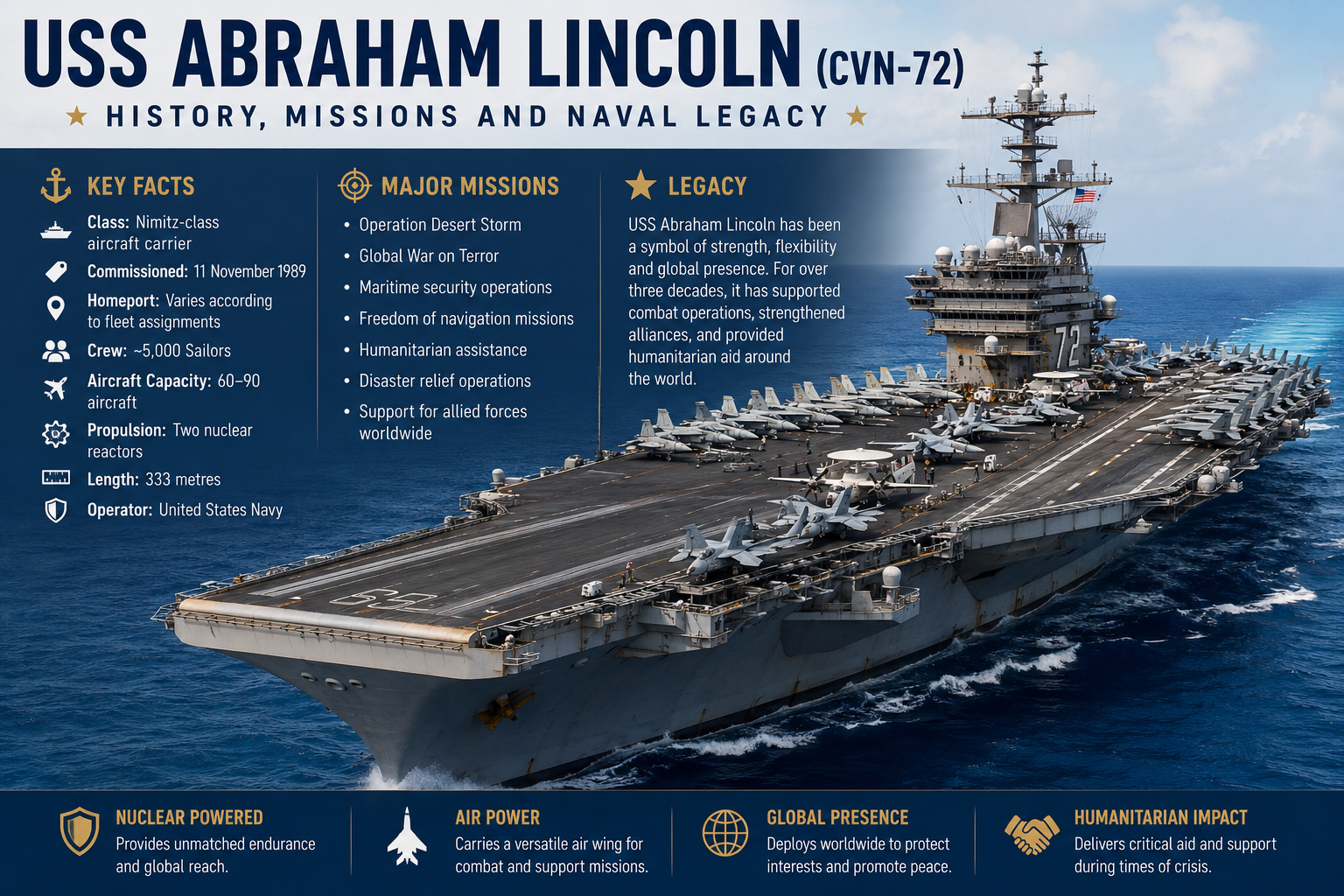
The USS Abraham Lincoln (CVN-72) is a nuclear-powered aircraft carrier operated by the United States Navy. It belongs to the Nimitz class, a group of supercarriers designed to provide unmatched naval aviation capabilities.
Aircraft carriers serve as floating airbases, allowing military aircraft to operate far from traditional land-based runways. This capability enables rapid response to military crises, humanitarian emergencies and strategic deployments around the globe.
The USS Abraham Lincoln has become one of the most recognisable carriers in the US Navy due to its extensive operational history and participation in numerous significant missions.
| Feature | Details |
|---|---|
| Name | USS Abraham Lincoln |
| Hull Number | CVN-72 |
| Class | Nimitz-class aircraft carrier |
| Operator | United States Navy |
| Propulsion | Two nuclear reactors |
| Length | Approximately 333 metres |
| Crew | Around 5,000 personnel |
| Aircraft Capacity | Approximately 60–90 aircraft |
| Commissioned | 1989 |
| Homeport | Varies according to fleet assignments |
The USS Abraham Lincoln was built during the Cold War era when the United States sought to maintain a powerful naval presence worldwide.
Construction began at Newport News Shipbuilding in Virginia, one of the world’s leading shipbuilding facilities. After years of development and testing, the vessel was officially commissioned in 1989.
Its naming honoured President Abraham Lincoln, one of America’s most influential leaders, known for preserving the Union during the American Civil War.
Following commissioning, the carrier quickly became an active part of the Pacific Fleet.
Its early deployments focused on maintaining stability, supporting alliances and demonstrating American naval strength in strategically important regions.
The vessel soon established itself as a reliable platform capable of supporting complex military operations across vast distances.
The USS Abraham Lincoln is classified as a supercarrier due to its immense size, advanced technology and operational flexibility.
Several features contribute to its effectiveness:
The carrier is powered by two nuclear reactors.
Benefits include:
Unlike conventional ships, nuclear-powered carriers can remain at sea for extended periods without refuelling.
The expansive flight deck functions as a mobile airport.
It supports:
This capability enables the carrier to conduct independent operations far from land-based support.
The USS Abraham Lincoln features sophisticated systems for:
These technologies help ensure operational effectiveness in challenging environments.
The carrier serves as the home for a Carrier Air Wing, consisting of multiple aircraft types.
Common aircraft include:
Modern fighter jets provide:
These specialised aircraft help:
These platforms extend radar coverage and improve battlefield awareness.
Helicopters support:
Together, these aircraft create a highly versatile combat force.
One of the carrier’s earliest significant deployments occurred during the Gulf crisis.
The USS Abraham Lincoln supported coalition operations aimed at defending regional stability and restoring international order.
Its aircraft contributed to combat readiness and strategic deterrence efforts.
Throughout its service life, the carrier has participated in numerous deployments across the Middle East.
These missions often involved:
Its presence provided flexibility and rapid-response capabilities in a strategically important region.
Beyond combat operations, the USS Abraham Lincoln routinely participates in:
These deployments strengthen international partnerships and promote stability.
Aircraft carriers are not solely instruments of warfare.
The USS Abraham Lincoln has also participated in humanitarian missions that demonstrate the broader value of naval power.
During natural disasters, carriers can rapidly deliver:
The ship’s resources allow it to function as a temporary support centre for affected communities.
This capability makes aircraft carriers valuable tools during international emergencies.
Despite advances in missiles, drones and cyber warfare, aircraft carriers remain central to military strategy.
The USS Abraham Lincoln provides:
The carrier can quickly move to crisis areas without requiring foreign bases.
Aircraft launched from the carrier can conduct operations hundreds of kilometres away.
The visible presence of a carrier strike group often discourages potential aggression.
Carriers can adapt to changing mission requirements, ranging from combat operations to humanitarian assistance.
| Feature | USS Abraham Lincoln | Conventional Carrier |
| Propulsion | Nuclear | Conventional Fuel |
| Endurance | Extremely Long | Limited by Fuel |
| Aircraft Capacity | High | Moderate |
| Global Reach | Exceptional | Limited |
| Operational Flexibility | Very High | Moderate |
The nuclear propulsion system gives the USS Abraham Lincoln significant advantages in endurance and operational range.
Operating a vessel of this size presents ongoing challenges.
Regular maintenance ensures:
Modern threats require continuous improvements.
Recent upgrades focus on:
The carrier must remain effective against:
Continuous modernisation helps maintain its strategic value.
The USS Abraham Lincoln represents decades of technological innovation and operational excellence.
Its legacy includes:
Lessons learned from the USS Abraham Lincoln have helped shape modern carrier operations and future naval planning.
As naval warfare evolves, the experience gained from operating Nimitz-class carriers continues to influence strategic decision-making.
The vessel has gained public attention through media coverage, documentaries and historical accounts of its deployments.
For many observers, it symbolises the capability and reach of the United States Navy.
The story of the USS Abraham Lincoln highlights several important lessons:
These lessons continue to shape naval strategy today.
The USS Abraham Lincoln stands as one of the most important aircraft carriers in modern naval history. Since its commissioning in 1989, the vessel has participated in military operations, humanitarian missions and international security efforts across the globe.
Its nuclear propulsion, advanced aviation capabilities and operational versatility have enabled it to remain a vital asset for the United States Navy for decades. More than just a warship, the USS Abraham Lincoln serves as a symbol of technological innovation, strategic readiness and global maritime presence.
As military challenges continue to evolve, the legacy of the USS Abraham Lincoln will remain closely connected to the ongoing development of modern naval warfare and international security operations.