 11
11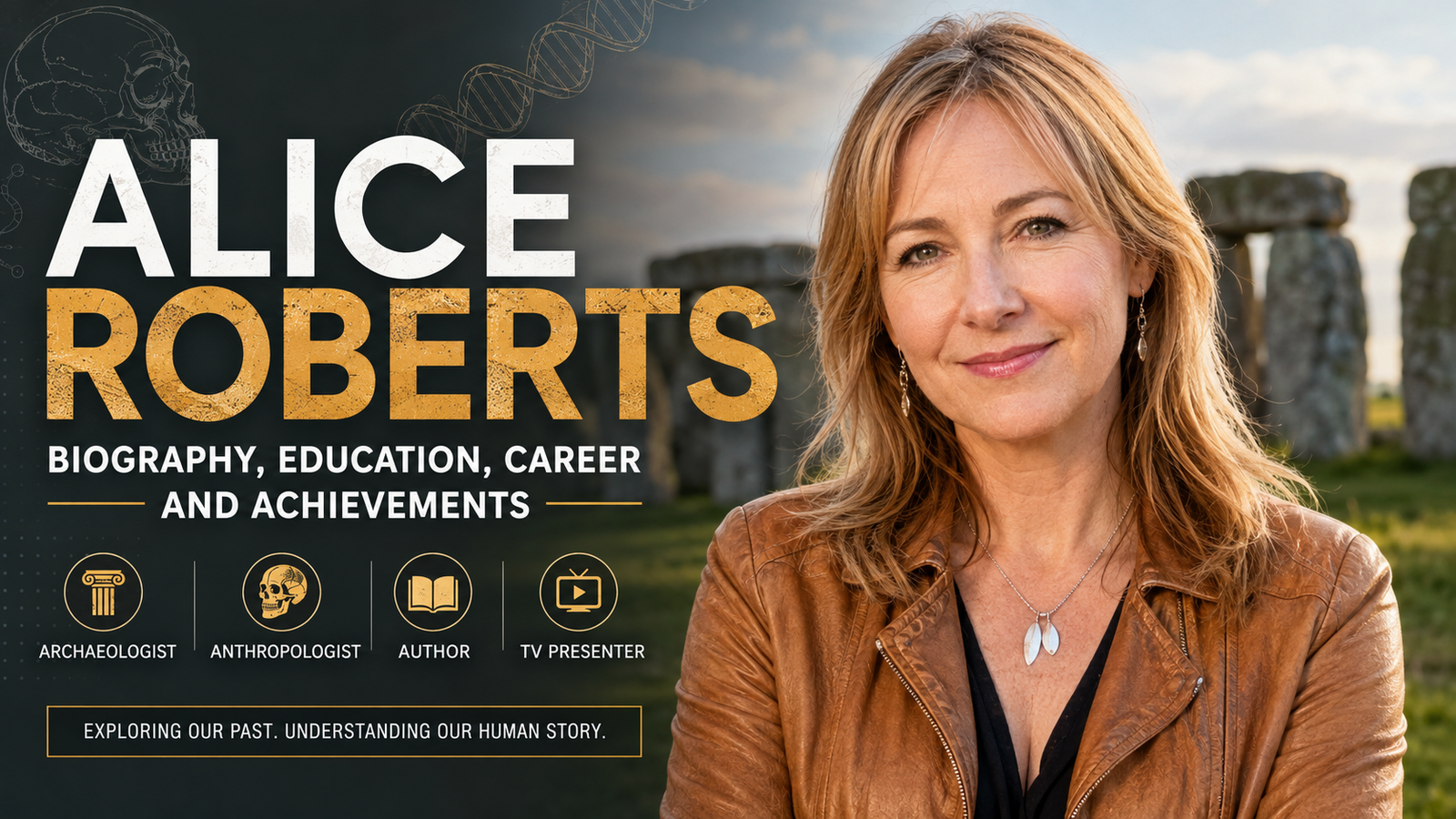
Alice Roberts is a British academic, anatomist, biological anthropologist, author, and television presenter. She is widely recognised for presenting educational documentaries covering archaeology, evolution, ancient civilisations, genetics, and human history.
Her ability to explain scientific concepts clearly has made her one of Britain’s leading public educators. She combines evidence-based research with engaging storytelling, helping audiences understand topics that might otherwise seem complex.
Today, she is known for balancing several professional roles, including:
Alice Roberts was born in Bristol, England, where she spent much of her childhood. From an early age, she developed a fascination with biology, nature, and the human body.
Her interest in science was encouraged through education and curiosity about how humans evolved and adapted over time. Rather than focusing on a single scientific discipline, she became interested in understanding connections between medicine, anatomy, archaeology, and evolution.
This broad curiosity would later become the defining feature of her career.
Education has played a central role throughout the Alice Roberts biography.
She attended school in Bristol before studying medicine at the University of Wales College of Medicine in Cardiff.
During medical school she developed strong interests in:
Although she qualified as a medical doctor, her passion increasingly shifted towards teaching anatomy and conducting research rather than practising clinical medicine full-time.
Her educational background gave her a rare combination of:
These strengths would later distinguish her television work from many other presenters.
After qualifying in medicine, Alice Roberts initially worked in clinical practice.
However, she soon realised that her greatest interest lay in education and anatomy rather than hospital medicine.
Her early academic work focused on:
Teaching future doctors allowed her to combine scientific knowledge with communication skills, preparing her for future opportunities in broadcasting.
Alice Roberts gradually built a successful university career.
She became involved in higher education, teaching anatomy while expanding her research interests into biological anthropology and archaeology.
Her academic work explores topics including:
Her interdisciplinary approach has helped connect different scientific fields into accessible narratives for students and the wider public.
One of the defining chapters in the Alice Roberts biography is her successful television career.
She first gained wider public recognition through educational documentaries focusing on archaeology and natural history.
Her approachable presentation style, scientific credibility, and enthusiasm quickly made her popular with audiences.
Rather than sensationalising discoveries, she explains:
This balanced approach has earned respect from both viewers and academics.
Alice Roberts has presented numerous educational programmes covering history, archaeology, and science.
Some of her best-known television work includes documentaries exploring:
She has investigated prehistoric monuments, ancient settlements, and early communities across Britain.
Topics include:
Evolution remains one of her strongest areas of expertise.
Her documentaries explain:
These programmes help viewers understand how modern humans developed over thousands of years.
Alice Roberts frequently visits excavation sites to explain:
Rather than simply presenting discoveries, she explains how scientists reach their conclusions.
Several documentaries focus on British history from prehistoric times through the medieval period.
Subjects include:
Alongside broadcasting, Alice Roberts has established herself as a successful non-fiction author.
Her books combine scientific evidence with engaging storytelling.
Common themes include:
Her writing style appeals to both general readers and science enthusiasts because it avoids unnecessary jargon while maintaining scientific accuracy.
Many readers appreciate how she explains difficult concepts using practical examples and clear language.
Although widely recognised from television, Alice Roberts continues to contribute to academic research.
Her work often focuses on understanding the relationship between biological evidence and archaeological discoveries.
Research areas include:
Studying how humans evolved through fossil evidence and comparative anatomy.
Examining how human populations have changed across different environments and historical periods.
Working alongside archaeologists to interpret skeletal remains and understand ancient communities.
Modern DNA research has transformed our understanding of migration and ancestry.
Alice Roberts frequently explains how genetic evidence complements archaeological discoveries.
Her work helps answer questions such as:
These questions remain central to understanding human history.
Throughout her career, Alice Roberts has received recognition for both academic excellence and science communication.
Her achievements include:
Her greatest achievement may be making complex scientific research understandable for millions of people.
Science communication has become one of Alice Roberts’ defining strengths.
She regularly delivers talks covering topics such as:
Her presentations emphasise evidence-based reasoning rather than speculation.
She encourages audiences to ask questions, evaluate evidence, and remain curious about scientific discoveries.
Several factors explain her lasting popularity.
Unlike many television presenters, Alice Roberts actively combines broadcasting with academic research.
She avoids technical language whenever possible, making science easier to understand.
Her documentaries focus on facts supported by research rather than sensational claims.
Her enthusiasm encourages audiences to become interested in history, archaeology, and science.
She connects:
This broad expertise gives her programmes depth and credibility.
| Year/Period | Career Milestone |
|---|---|
| Early education | Developed an interest in biology and anatomy |
| University | Studied medicine |
| Medical qualification | Qualified as a doctor |
| Academic career | Began teaching anatomy |
| Research | Expanded into biological anthropology |
| Television | Started presenting science documentaries |
| Publishing | Released popular science books |
| Professor | Continued academic leadership alongside broadcasting |
| Area | Achievement |
|---|---|
| Medicine | Qualified medical doctor |
| Anatomy | University lecturer and professor |
| Anthropology | Conducted biological research |
| Television | Presented educational documentaries |
| Writing | Published bestselling science books |
| Education | Promoted public understanding of science |
Many television science presenters specialise in a single subject.
Alice Roberts combines expertise across several disciplines.
These include:
This multidisciplinary perspective allows her to explain how discoveries from different scientific fields connect together.
For example, a documentary about ancient Britain may combine archaeological excavation, skeletal analysis, DNA research, and historical evidence into one coherent narrative.
This integrated approach makes her work especially valuable for viewers interested in understanding the bigger picture.
| Fact | Information |
|---|---|
| Profession | Academic, author and television presenter |
| Nationality | British |
| Main Expertise | Anatomy and biological anthropology |
| Known For | Science documentaries and books |
| Academic Background | Medicine and anatomy |
| Main Interests | Human evolution, archaeology and genetics |
The Alice Roberts biography is an excellent example of how academic expertise can be combined with outstanding public communication. From studying medicine to becoming a respected professor, bestselling author, and acclaimed television presenter, she has dedicated her career to helping people understand science and human history.
Her work demonstrates that complex subjects do not have to be difficult to understand when explained with clarity, evidence, and enthusiasm. Through documentaries, books, university teaching, and public lectures, Alice Roberts has inspired countless people to explore archaeology, anatomy, evolution, and the fascinating story of humanity.
As scientific discoveries continue to reshape our understanding of the past, her balanced and evidence-based approach ensures she remains one of Britain’s most trusted science communicators.